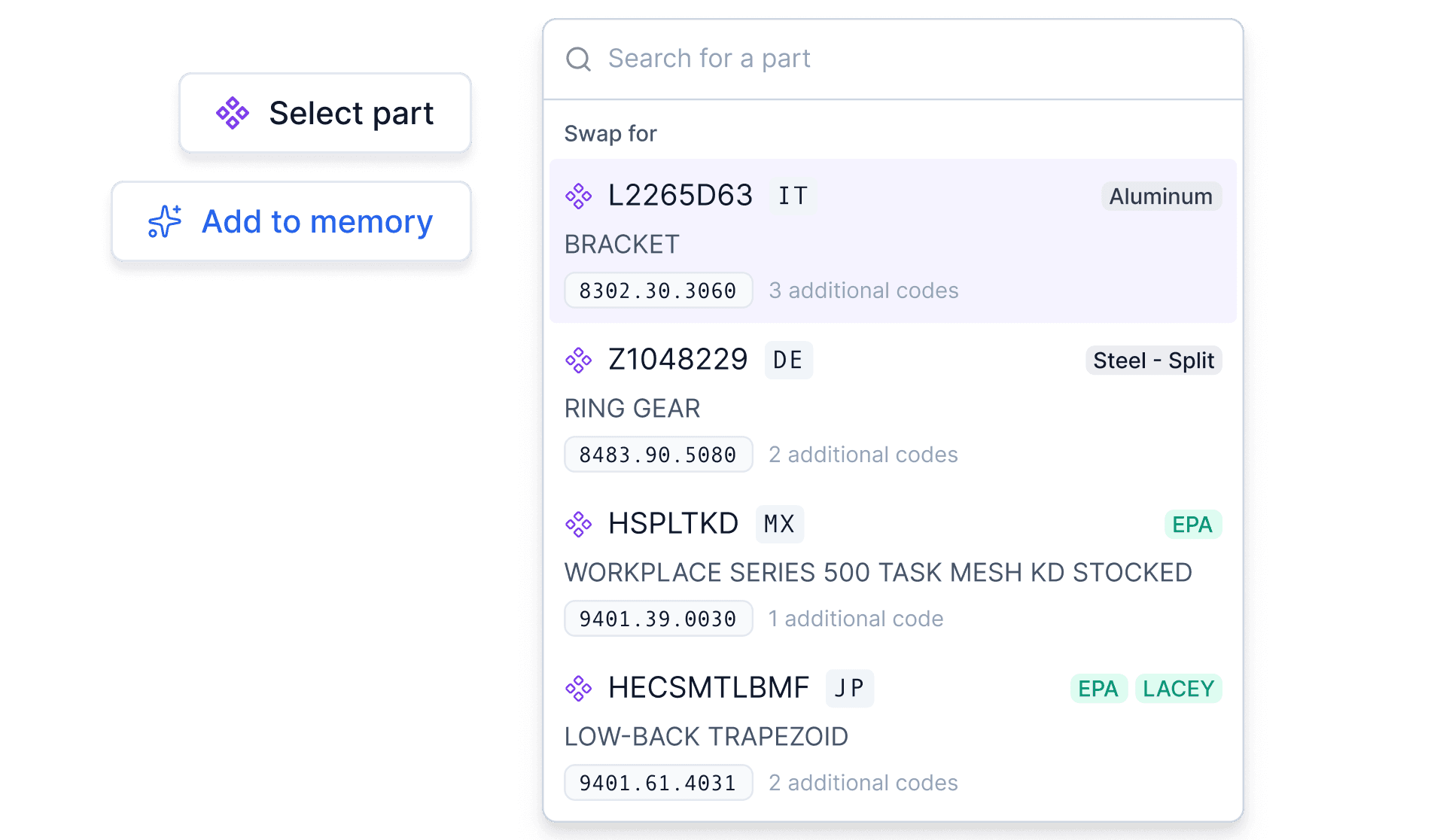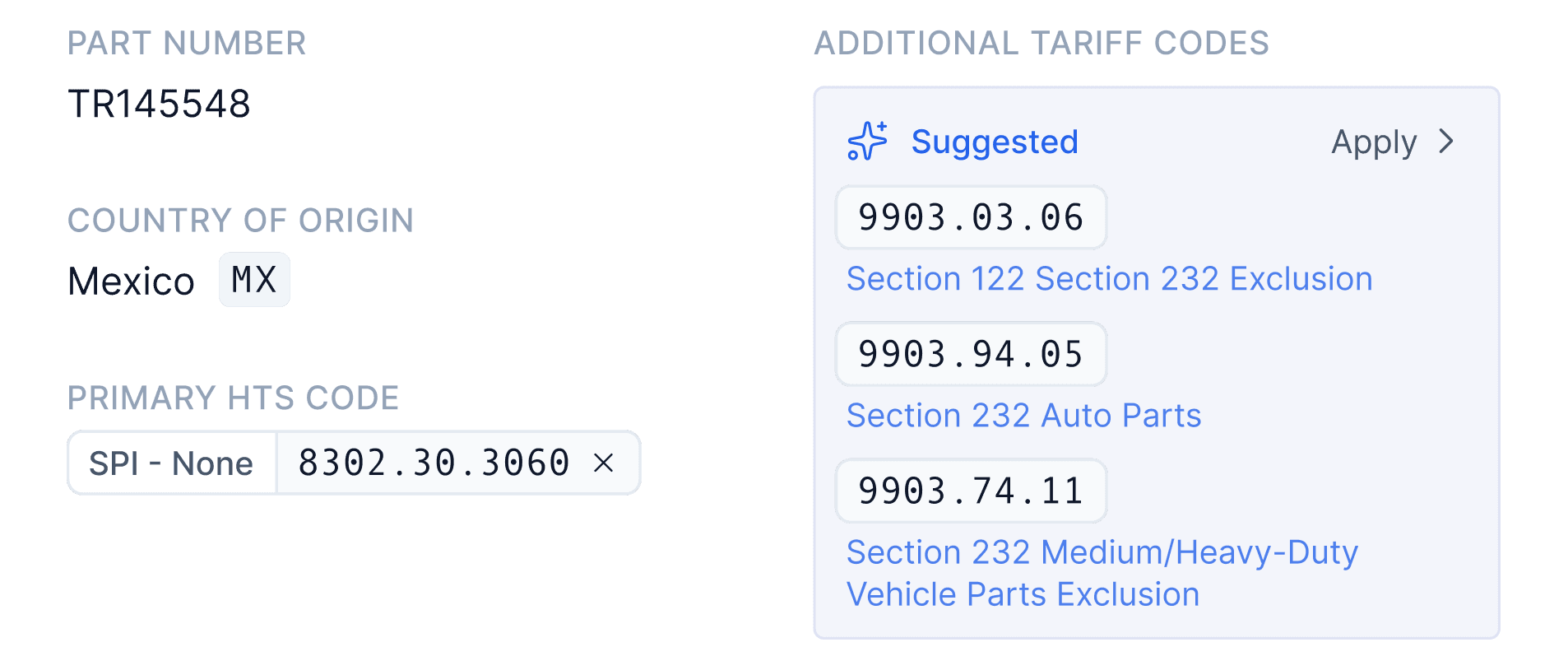
Your brokers already know how to classify products. Cervo makes sure that expertise scales through a living parts library - and automates the Chapter 99 tariff stacking that's become the hardest part of every customs entry. No standalone lookup tools. No tab switching. No manually cross-referencing Federal Register notices.
Everyone focuses on the 10-digit product code. But in 2026, the real compliance risk lives in Chapter 99. A single entry line may carry Section 232 tariffs, Section 301 duties, IEEPA tariffs, and AD/CVD orders - all layered through Chapter 99 provisions that shift with every new proclamation. Miss one subheading and you're filing a wrong entry, even if the base code is perfect.
The tariff environment has made entry filing significantly harder in recent years. Chapter 99 provisions layer additional duties on top of the base rate - Section 232 on steel, aluminum, and now copper with a five-tier structure based on composition and origin. Section 301 on Chinese-origin goods. IEEPA tariffs. AD/CVD orders. The rates and exclusions change frequently, sometimes with days of notice.
Meanwhile, the 10-digit product classification itself depends on institutional knowledge that's fragile. Senior entry writers know which codes apply to which products for which importers. But when an experienced classifier leaves, the brokerage loses years of accumulated expertise. New hires take months to develop the same judgment, and error rates climb.
Standalone HTS code software doesn't solve either problem. It treats every classification as a new event with no memory of prior decisions, has no connection to the entry being built, and offers no awareness of the Chapter 99 provisions that apply. Your entry writer classifies in one tool, then manually transfers the result to another - a workflow that is slow, error-prone, and disconnected.
Cervo does not offer HTS classification as a standalone lookup. Your brokers' classification expertise is preserved in a parts library and applied automatically - while Chapter 99 tariff stacking is handled by the system in real time.
Chapter 99 is where most entry errors become costly. A product with a perfectly correct base HTS code may also be subject to Section 301 duties (up to 25% on Chinese-origin goods), Section 232 tariffs (now a five-tier structure for steel, aluminum, and copper based on composition and origin), IEEPA tariffs, and antidumping or countervailing duties. Each of these provisions has its own Chapter 99 subheading, its own rate, and its own exclusion logic.
Cervo's tariff engine handles the full stacking sequence automatically. Once the base HTS code is established - whether from the parts library or the broker's own classification - the system identifies every applicable Chapter 99 provision based on the code, country of origin, and current trade policy. Exclusions are checked. Rates are pulled from a tariff database that is maintained in real time using AI interpretation of CBP guidance, reviewed by licensed customs brokers. When the country of origin changes on a line item, Cervo automatically recommends the correct Chapter 99 codes for the new origin and ensures they are applied in the proper stacking order.
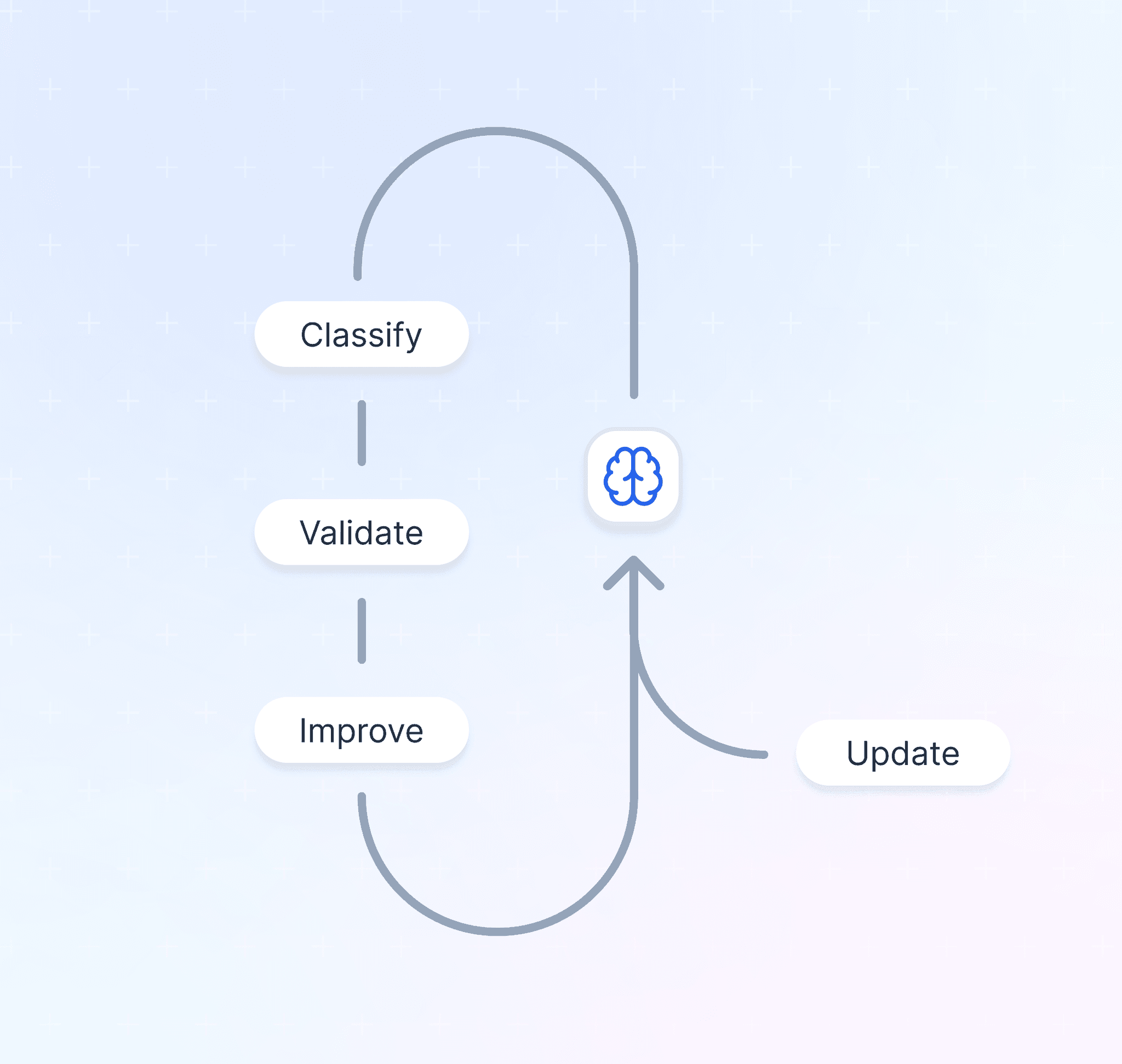
This matters because the stacking rules change. New tariff actions are announced, exclusions expire, rates are modified - sometimes with minimal lead time. A tariff database that was accurate last month may produce wrong results today. Cervo's real-time update process ensures your entries reflect current rates, not stale data.
For goods subject to steel or aluminum splits, the Chapter 99 stacking integrates with the split calculation. The steel portion receives its Section 232 code and rate, while the non-steel portion receives any other applicable Chapter 99 provisions. The entire calculation happens in seconds.
| Topic | Standalone HTS Lookup Tools | Cervo AI |
|---|---|---|
| Classification memory | Every lookup is a new event - no recall of prior decisions | Parts library stores validated classifications for reuse |
| Chapter 99 stacking | Manual or limited - user must identify applicable provisions | Automatic stacking of Section 301, 232, IEEPA, AD/CVD |
| Tariff data freshness | Periodic updates, often lagging behind CBP changes | Real-time updates with AI interpretation and broker review |
| Entry integration | Copy-paste results into a separate entry system | Classification feeds directly into the 7501 draft |
| Institutional knowledge | Lost when the user closes the tab | Preserved in parts library and Agent Studio rules |
| New product handling | Single suggested code with no rationale | Flagged for broker classification with extracted product data and context |
A top-3 global freight forwarder achieved an 88% reduction in entry processing time after switching from standalone tools to Cervo's integrated parts library and Chapter 99 stacking workflow.